Build vs. Buy: Should You Build Investor Verification In-House?
The build-vs-buy question sounds 50/50 until you list everything a real verification stack actually requires.
 Jesse Prince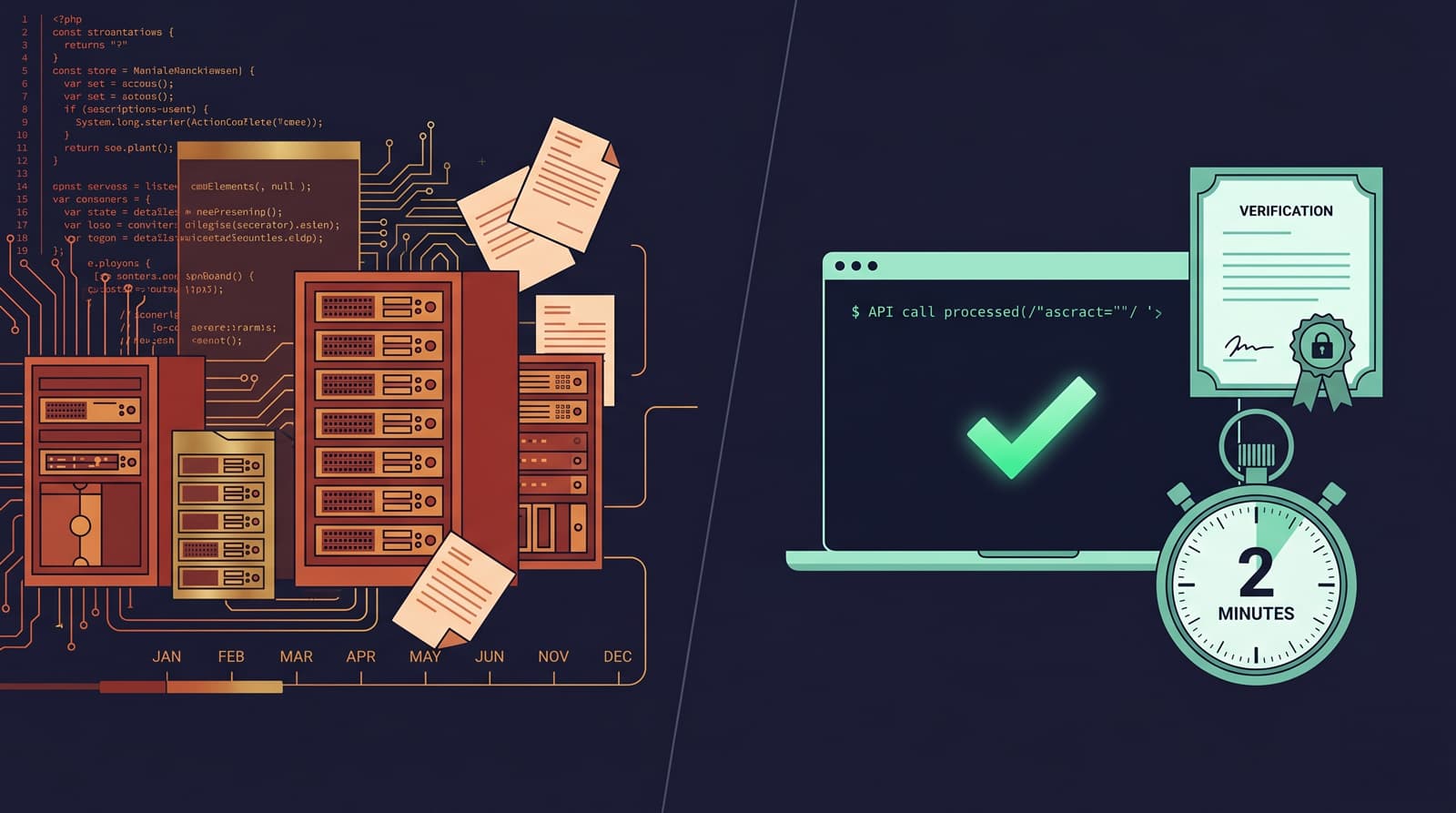
For most teams, buying is the right call.
For most fund managers and platforms, buying accredited investor verification is the right call. The build-vs-buy question sounds 50/50 until you list what a real verification stack actually requires: document classification AI, multi-provider failover, SEC compliance tracking, certificate generation, identity verification, and ongoing maintenance. The build typically takes 6 to 12 months and costs $200K to $500K in engineering time before a single investor is verified. We do it for $10 per check in about two minutes. If verification is not your core product, the math almost never works in your favor.
The appeal of building it yourself
Control is the big one. Owning the stack means owning the roadmap. You decide which document types to support, how to handle edge cases, and when to ship updates. Vendor lock-in feels avoidable when the IP lives in your own repo and on your own infrastructure.
Customization is the second pull. A platform with unique compliance needs (international issuers, multi-tier accreditation, exotic asset classes) might want flows that off-the-shelf tools do not expose. Building gives you a clean canvas.
Then there is the perception that the work is small. From the outside, accredited investor verification looks like a document upload, an OCR call, a few rules, and a PDF generator. A weekend project for a senior engineer, maybe a sprint. That last assumption is where the estimate breaks down. The visible surface is the easy part. What sits underneath it is what actually drives the timeline and cost.
What building actually requires
The work splits into seven systems that have to ship together for the product to be useful. Skip any one of them and the platform does not clear the bar that 506(c) compliance demands.
I know because I built every one of these systems. I spent nine years running a real estate fund under Regulation A+, which meant non-accredited investor access and no verification requirement. When we started evaluating Regulation D with 506(c) for higher check sizes, I ran straight into the verification wall. The process was slow, expensive, and the economics killed conversion. I couldn't move forward with the raise because the cost and timeline of verifying every investor made the math fall apart. That's what inspired IncrediVer. When I started building the solution, I thought it would take a few months. The document classifier alone took longer than I expected. The AI pipeline started with one provider, then that provider went down, so I built failover across three. The certificate generator, the webhook system, the email notifications, the dashboard... each one felt like a weekend project until I was actually in it. I'm not theorizing about what the build costs. I'm telling you what I spent.
1. Document classification
Tax returns, W-2s, K-1s, brokerage statements, bank statements, CPA letters, and attorney letters all look different. Each format requires its own classifier and field-extraction logic. A 1040 has different signal lines than a Schwab brokerage statement, and a Series 65 confirmation looks nothing like either. Get the classifier wrong and you ask the investor for the wrong thing, which is exactly the friction point that drives drop-off.
2. AI/ML pipeline with failover
A single LLM provider is a single point of failure. Outages happen. Rate limits hit. Models get deprecated on a schedule that does not care about your raise. We run three providers in priority order with automatic failover so a single outage never stalls verifications. Building that yourself means provisioning accounts with each provider, abstracting the prompt layer, monitoring quality across versions, and writing the routing logic. None of it is exotic. All of it is work.
3. SEC compliance tracking
The accredited investor definition was last expanded in 2020 to include holders of Series 7, 65, and 82 licenses. It will change again. Whoever owns the verification system owns the obligation to update logic when rules shift. Miss an update and your verifications stop being defensible at exactly the moment an issuer needs them to hold up.
4. Certificate generation
Every passing verification produces a PDF certificate with a unique ID, the verification method used, the date, and a signed hash so an issuer can prove what was reviewed. Certificates need a public verification URL, a QR code, and tamper-evident storage. None of this is hard. All of it is work that has to ship before the first real customer.
5. Identity verification and liveness
Document review proves financial qualification. It does not prove the person uploading the document is the person named on it. A liveness-checked face match keeps fraudsters from using stolen tax returns. Building this requires integrating with a biometric provider, handling the consent flow, and managing the photo evidence in compliance with state biometric privacy laws.
6. Notifications, webhooks, and a fund-manager dashboard
The platform has to email investors at each step, fire webhooks to your CRM or fund admin, and give fund managers a dashboard to track pipeline. A spreadsheet works for the first ten investors. By the hundredth, the dashboard is not optional, and by the thousandth, neither are the integrations.
7. Ongoing maintenance
Document formats drift. Banks redesign statements. The IRS adds a new schedule. A model provider releases a breaking change. Security patches need to ship. None of it stops once the product is live. Maintenance is the line item nobody includes in the build estimate and everyone pays anyway.
The hidden costs that don't show up in the spec
Engineering time, fully loaded
A senior engineer who can ship this work costs $150K to $250K per year fully loaded once you account for benefits, equipment, equity, and overhead. The build needs at least one ML engineer and one backend engineer for six to twelve months. That is $200K to $500K of capacity before the product handles a single real verification. The number scales with how cleanly the spec is defined and how much of the team is actually dedicated to it.
Opportunity cost
Every engineer-hour spent on verification is an engineer-hour not spent on what differentiates your platform. If you are a capital formation platform, your investors do not pick you because your in-house verification is faster than ours. They pick you because your deal flow, your investor experience, or your distribution is better. Verification is table stakes. The question is whether you want to build table stakes or rent them.
Compliance liability
When your in-house system makes a wrong call, the buck stops with you. If a 506(c) verification is challenged in an SEC action and the issuer relied on your platform, the documentation, methodology, and audit trail are all on your side of the line. Buying from a third-party verification service does not erase the risk, but it shifts a meaningful portion to a vendor who specializes in defending the methodology and updates the logic when rules change.
Security and audit overhead
Investor PII, including tax returns and bank statements, is exactly the data class that triggers SOC 2, vendor security reviews, biometric privacy laws, and breach notification statutes. Building the verification system means owning the security posture for that data, the penetration testing cadence, and the audit reports your enterprise customers will demand before they sign. The cost is not the audits themselves. It is the engineering hours required to remediate every finding.
Try it before you build it.
$10 per verification. Two minutes per investor. See for yourself.
Start Free TrialWhen buying is the obvious answer
If you are running fewer than 10,000 verifications per year, the math does not work for a build. The amortized cost per verification on a $300K build over three years is $10 per check before you have shipped a single bug fix or compliance update. Our $10 covers the build, the failover, the certificates, the updates, and the audits.
If verification is not the product your platform exists to deliver, building it locks engineers into infrastructure work that does not show up in your differentiation. The fundraising platform with the best deal flow wins on deal flow. The transfer agent with the best issuer dashboard wins on issuer experience. Neither wins by having a homegrown verification stack.
If you want engineering focused on what makes your platform unique, buy. If you want to be 506(c) compliant by Friday, buy. If you want to spend a Q1 retro talking about anything other than tax return classifiers, buy.
When building can actually pencil out
The answer is not universal. Building can make sense at the high end of the volume curve when verification is genuinely the product.
If you are a large transfer agent processing 100,000 or more verifications per year, the per-verification cost of a third-party service starts to dominate your COGS. A million- dollar engineering investment might amortize cleanly across that volume.
If verification is the differentiator, owning the stack is owning the product. A private markets platform whose moat is verification speed and integration depth has a real argument for building.
Even in those cases, the white-label API is usually the better answer. We let high-volume platforms embed our verification flow under their own brand, with their own pricing per issuer, while we keep the model provider failover, SEC compliance updates, and certificate infrastructure. You get control over the experience without the cost of building the parts that do not differentiate you.
Build vs. buy at a glance
Here is how the two paths compare on the dimensions that actually drive the decision:
The bottom line
Most teams should buy. The build is real, the timeline is long, and the engineering hours are needed somewhere with higher leverage. We run the verification stack so you do not have to.
If you are running fewer than 10,000 verifications a year, our pricing makes the build math indefensible. Pay As You Go starts at $10 per check. The Growth plan covers 100 verifications a month at $497 with overage at $8.50 each.
If you are evaluating real numbers, our breakdown of the real cost of 506(c) verification covers what the invoice does not show, and our head-to-head with VerifyInvestor walks through how IncrediVer stacks up against the legacy attorney-review approach.
Build what only you can build. Rent the rest.